

a new approach to sight singing 6th edition pdf
Article Plan: A New Approach to Sight Singing 6th Edition PDF
This article details the comprehensive guide to the 6th edition, exploring its content, authors, and availability in formats like PDF and print.
“A New Approach to Sight Singing” stands as a cornerstone resource in music education, renowned for its systematic and progressive methodology. The 6th edition, authored by Sol Berkowitz, Gabriel Fontrier, Perry Goldstein, and Edward Smaldone, continues this legacy, offering a meticulously crafted anthology for developing sight-reading proficiency.
Widely utilized in collegiate curricula, the book provides a wealth of exercises – melodies, themes, duets, and improvisation studies – designed to enhance both melodic and rhythmic understanding. Available in multiple formats, including a convenient PDF version accessible online via platforms like PDFCOFFEE.COM and the Internet Archive, it caters to diverse learning preferences. Its enduring value lies in its ability to build a strong foundation in musical literacy.
Authors and Their Backgrounds

“A New Approach to Sight Singing” benefits from the combined expertise of four distinguished music educators. Sol Berkowitz, Gabriel Fontrier, Perry Goldstein, and Edward Smaldone each brought unique skills to the anthology’s development. Their collaborative effort resulted in a comprehensive resource widely adopted in music programs.
While specific details on each author’s individual contributions aren’t readily available in the provided snippets, their collective experience is evident in the book’s pedagogical approach. The 6th edition reflects their dedication to fostering musical literacy, offering a progressive system accessible through various formats, including a readily available PDF version for convenient study.
2.1 Sol Berkowitz: Contributions to Music Education
Sol Berkowitz is a key figure behind “A New Approach to Sight Singing,” a cornerstone text in music education. While detailed biographical information isn’t present in the provided sources, his name consistently appears as a primary author across multiple editions, including the 6th edition available as a PDF.
Berkowitz’s sustained involvement suggests a deep commitment to developing effective sight-reading pedagogy. The anthology’s enduring popularity, and its continued relevance in contemporary curricula, speaks to the quality and impact of his contributions. His work, alongside his co-authors, provides a structured path to musical fluency.
2.2 Gabriel Fontrier: Expertise and Influence
Gabriel Fontrier is prominently listed as a co-author of “A New Approach to Sight Singing,” including the widely accessible 6th edition in PDF format. Like Sol Berkowitz, specific details regarding his individual expertise aren’t readily available in the provided snippets. However, his consistent authorship across editions signifies a substantial and lasting influence on the book’s methodology.
Fontrier’s contribution likely centers on the pedagogical framework and musical content within the anthology. His collaboration with Berkowitz, Goldstein, and Smaldone has resulted in a highly regarded resource for students and educators alike, fostering sight-reading skills.
2.3 Perry Goldstein: Role in the Anthology

Perry Goldstein is a key contributor to “A New Approach to Sight Singing,” appearing as a co-author on the 6th edition, available in formats including a convenient PDF version. Similar to Gabriel Fontrier, detailed biographical information isn’t explicitly provided in the available text. However, his sustained involvement across multiple editions demonstrates a significant role in shaping the anthology’s content and approach.
Goldstein’s expertise likely focuses on refining the musical examples and exercises, ensuring they effectively build sight-reading proficiency. His collaborative work with Berkowitz, Fontrier, and Smaldone has cemented the book’s position as a standard resource.
2.4 Edward Smaldone: Contributions to the 6th Edition
Edward Smaldone represents a vital link to the continued relevance of “A New Approach to Sight Singing,” particularly in the 6th edition, readily accessible as a PDF download. His contributions center on updating and expanding the anthology to meet contemporary pedagogical needs. While specific details regarding his expertise aren’t widely publicized, his role signifies a commitment to modernizing the text.
Smaldone’s work likely involved incorporating new musical styles and addressing evolving challenges in music education. His collaboration ensures the book remains a cornerstone resource for students and educators alike, available through W.W. Norton & Company.
Overview of the 6th Edition Updates
The 6th edition of “A New Approach to Sight Singing” builds upon its established foundation, offering updated content for modern music education. Available as a convenient PDF, the revisions aim to enhance the learning experience. Updates include expanded musical examples and potentially refined exercises to address current pedagogical practices.
While specific changes aren’t detailed extensively online, the anthology’s enduring popularity suggests significant improvements. The 330-page book (25cm) maintains its core principles while adapting to the needs of contemporary students, ensuring its continued relevance as a key resource.
Core Principles of the Sight-Singing Approach
“A New Approach to Sight Singing” centers on developing a strong musical foundation through methodical practice. A key principle is melodic understanding, fostering the ability to recognize intervals and patterns. Equally vital is rhythmic accuracy, achieved through careful subdivision and precise execution.
The method emphasizes the importance of key signatures and scales, enabling students to confidently navigate different tonal contexts; This holistic approach, readily accessible in the PDF version, aims to build musicianship beyond simply decoding notation, promoting a deeper connection to the music itself.
4.1 Emphasis on Melodic Understanding
“A New Approach to Sight Singing” prioritizes melodic comprehension as the cornerstone of successful sight-reading. The 6th edition PDF reinforces this through exercises designed to build interval recognition and melodic pattern identification. Students learn to anticipate melodic direction, fostering a proactive rather than reactive reading style.
This focus extends beyond simply identifying notes; it encourages understanding the shape of melodies and their underlying harmonic implications. The anthology’s progressive difficulty ensures gradual development, solidifying melodic understanding before introducing rhythmic complexities. This approach, available in the convenient PDF format, builds confident musicians.
4.2 Rhythmic Accuracy and Subdivision
“A New Approach to Sight Singing’s” 6th edition PDF places significant emphasis on rhythmic precision. The method systematically introduces rhythmic concepts, starting with simple patterns and progressing to complex subdivisions. Students are guided to internalize beat divisions – halves, quarters, eighths, and beyond – crucial for accurate performance.

Exercises within the PDF version actively train the ability to accurately perceive and execute rhythmic values. This isn’t merely about counting; it’s about feeling the rhythm. The anthology’s structure ensures a solid rhythmic foundation, enabling musicians to confidently navigate challenging rhythmic passages, enhancing overall musicality.
4.3 Importance of Key Signatures and Scales
“A New Approach to Sight Singing,” 6th Edition PDF, meticulously integrates key signatures and scales into the learning process. The anthology doesn’t treat these as isolated concepts, but rather as fundamental building blocks of melodic understanding. Students progressively encounter different keys, learning to quickly identify signatures and associated scales.
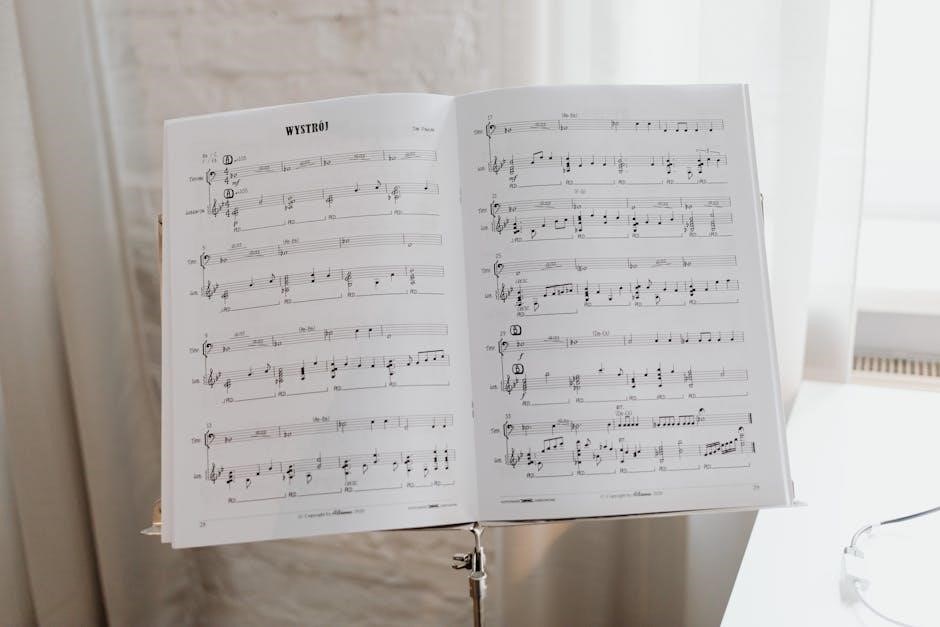
The PDF’s exercises are designed to reinforce this knowledge, prompting students to recognize scale degrees and intervals within each key. This fosters a deeper connection between theory and practice, enabling confident sight-reading across a wide range of tonal contexts. Mastery of scales and key signatures is presented as essential for fluent musical interpretation.
Content Breakdown: Sections of the Book
“A New Approach to Sight Singing,” 6th Edition PDF, is thoughtfully structured into distinct sections to facilitate progressive skill development. The core lies within Melodies, offering exercises of increasing difficulty. Themes and Variations cultivate analytical abilities, challenging students to recognize melodic transformations.
Duets enhance ensemble skills, promoting rhythmic precision and harmonic awareness. The innovative Play and Sing section bridges theory and practice, encouraging active engagement. Finally, Improvisation Studies foster creativity and a deeper understanding of musical structure. The PDF version maintains this organization, offering a seamless learning experience.
5.1 Melodies: Progressive Difficulty Levels
The “Melodies” section within the A New Approach to Sight Singing 6th Edition PDF is foundational, presenting exercises arranged by increasing complexity. Initial melodies focus on simple rhythms and diatonic scales, building confidence. As students progress, the PDF introduces chromaticism, syncopation, and wider melodic ranges.
This gradual ascent ensures mastery at each stage. The anthology’s careful sequencing allows students to internalize core sight-singing principles before tackling more challenging material. The PDF format allows for easy navigation between levels, supporting individualized learning and targeted practice.
5.2 Themes and Variations: Developing Analytical Skills
The “Themes and Variations” section of the A New Approach to Sight Singing 6th Edition PDF moves beyond rote reading, fostering analytical thinking. Students encounter a primary melodic theme, then sight-sing variations altering rhythm, harmony, or contour.
This approach, accessible within the PDF, trains the ear to recognize underlying structures amidst changes. It enhances harmonic awareness and melodic memory. The PDF’s format facilitates side-by-side comparison of theme and variations, solidifying comprehension. This section is crucial for developing musicianship and independent musical understanding.
5.3 Duets: Enhancing Ensemble Skills
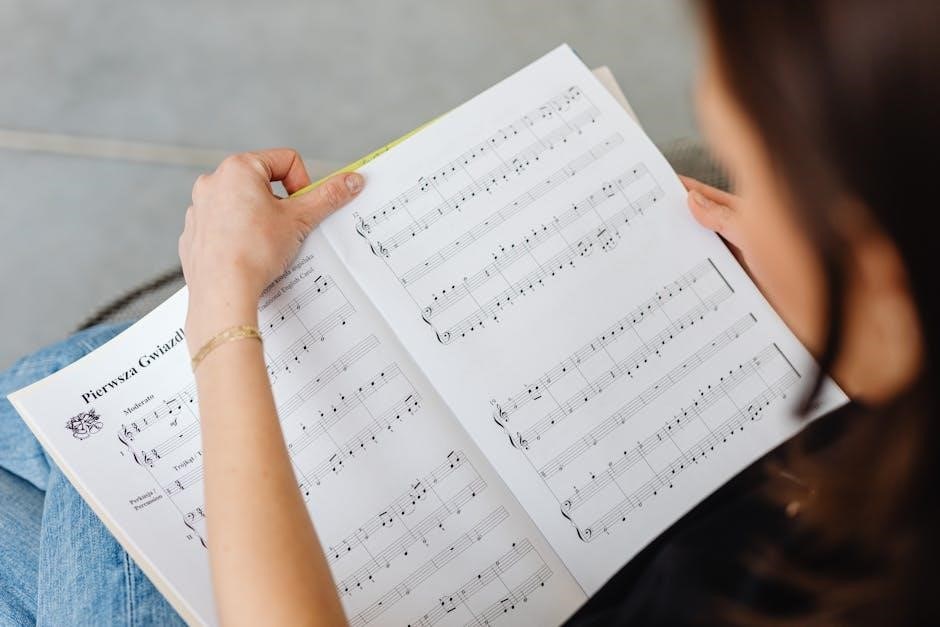
The Duets section within the A New Approach to Sight Singing 6th Edition PDF significantly elevates sight-singing practice. These aren’t merely parallel lines; they demand active listening and rhythmic precision from both singers.
Students learn to maintain their part while simultaneously internalizing the other’s melody, crucial for ensemble performance. The PDF format allows for convenient paired practice. This section, found in the anthology, develops independence, intonation, and the ability to blend – essential skills for any musician. It’s a practical application of theoretical knowledge.
5.4 Play and Sing: Connecting Theory to Practice
The “Play and Sing” section of A New Approach to Sight Singing, 6th Edition (available as a PDF) bridges the gap between music theory and practical application. This innovative approach encourages students to play rhythmic patterns on an instrument – piano is ideal – while simultaneously vocalizing melodic lines.
This dual engagement solidifies understanding of both rhythm and pitch. The PDF version facilitates easy access for both instrumentalists and vocalists. It’s a dynamic method, fostering a deeper, more intuitive grasp of musical concepts, moving beyond rote memorization and enhancing overall musicianship.
Supplementary Exercises and Their Purpose
A New Approach to Sight Singing, 6th Edition, in both print and PDF formats, includes a wealth of supplementary exercises designed to reinforce core concepts. These aren’t merely add-ons; they’re integral to mastering sight-reading skills. They target specific areas like intervallic recognition, rhythmic complexity, and key signature fluency.

The exercises progressively increase in difficulty, building confidence and competence. Accessing these through the PDF version allows for convenient printing and annotation. They provide targeted practice, addressing individual student needs and solidifying the theoretical foundations presented within the anthology’s main sections.
The Book’s Pedagogical Approach
A New Approach to Sight Singing, available as a PDF and in other formats, employs a sequential and cumulative pedagogical method. It begins with fundamental elements – rhythm and pitch – and gradually introduces more complex musical concepts. This structured approach ensures students build a solid foundation before tackling advanced material.
The anthology emphasizes a holistic understanding of music, connecting theory to practical application. Whether utilizing the print edition or the convenient PDF version, students are encouraged to actively engage with the material. This fosters independent learning and develops crucial musicianship skills, making it a cornerstone of music education.
Target Audience: Students and Educators
A New Approach to Sight Singing, including the accessible PDF edition, is primarily designed for undergraduate music students in college and university settings. However, its comprehensive nature also benefits high school students preparing for advanced musical studies. The anthology serves as an invaluable resource for both individual practice and classroom instruction.
Music educators will find the progressive exercises and varied content – easily accessed through the PDF – highly adaptable to diverse learning styles. It’s a staple in curricula, supporting the development of essential sight-reading skills for aspiring musicians of all levels.
Formats Available: PDF, eBook, Print
A New Approach to Sight Singing, 6th Edition, is conveniently available in multiple formats to suit diverse learning preferences. The widely sought-after PDF version allows for easy online access and portability, found on platforms like PDFCOFFEE.COM and the Internet Archive.
Additionally, readers can choose between a traditional print edition from W.W. Norton & Company and a digital eBook version. Comparing these options reveals the PDF’s immediate accessibility, while eBooks offer interactive features, and print provides a tactile learning experience. ISBN 9781324071563 identifies all versions.

9.1 Accessing the PDF Version Online
Finding the PDF version of A New Approach to Sight Singing, 6th Edition, is readily achievable through several online resources. PDFCOFFEE.COM is a prominent platform offering direct download access to the complete text by Berkowitz, Fontrier, Goldstein, and Smaldone.
The Internet Archive also provides access, enabling borrowing and streaming of the digital copy. These online avenues offer convenient and often free access to this essential music education resource. Users should verify the legitimacy of download sources to ensure a safe and reliable experience.
9.2 Comparing eBook and Print Editions
A New Approach to Sight Singing, 6th Edition, is available in eBook, print, and PDF formats, each offering distinct advantages; The print edition provides a traditional learning experience with physical pages for annotation and a tactile feel.
eBook versions offer portability and searchability, ideal for digital note-taking and on-the-go study. The PDF version, accessible online, provides immediate access but may lack interactive features found in dedicated eBook platforms. Choosing the best format depends on individual learning preferences and accessibility needs, with W.W. Norton & Company offering all options.
ISBN and Publication Details (9781324071563)
The 6th Edition of A New Approach to Sight Singing is uniquely identified by the ISBN 9781324071563. This ISBN is crucial for accurate identification when purchasing the book in any format – print, eBook, or PDF – from retailers like W.W. Norton & Company and online platforms.
Published by W.W. Norton & Company, this edition builds upon decades of success as a leading sight-singing anthology. The ISBN ensures you are acquiring the correct, updated version, containing the latest revisions and supplementary exercises. It’s essential for academic referencing and library cataloging.
Availability and Pricing (W.W. Norton & Company)
A New Approach to Sight Singing, 6th Edition, is primarily available through W.W. Norton & Company’s official website and major booksellers. Pricing varies depending on the chosen format – print, eBook, or PDF. While specific pricing fluctuates, W.W. Norton offers competitive rates for students and educators.
PDF versions can often be found through online retailers, but verifying the source’s legitimacy is crucial to ensure a legal and high-quality copy. Checking W.W. Norton’s site directly provides the most accurate and up-to-date pricing information and potential discounts.
Historical Context: Editions 1-5
Prior to the 6th edition, A New Approach to Sight Singing established itself as a cornerstone of music education over decades, with its first edition appearing in 1975. Subsequent editions (1980, 1986, 1997, and 2010) refined the methodology, responding to evolving pedagogical needs and student requirements.
Each revision built upon the core principles of melodic and rhythmic understanding, gradually incorporating new exercises and adapting to contemporary musical styles. The anthology’s enduring popularity stems from its progressive approach and comprehensive content, making it a trusted resource for generations of musicians.
Common Uses in Music Education Curricula
A New Approach to Sight Singing is widely integrated into diverse music education programs, from secondary schools to collegiate-level courses. It serves as a primary text in music theory, ear training, and ensemble classes, fostering essential skills for vocalists and instrumentalists alike.
Instructors utilize the book’s progressive exercises to develop students’ ability to accurately read and perform music at sight. The anthology’s versatility allows for customized assignments, catering to varying skill levels and musical interests. Its structured approach ensures a solid foundation in sight-reading proficiency.
Reviews and Reception of the 6th Edition
The 6th edition of A New Approach to Sight Singing has been met with positive reception from music educators and students. Many praise the updated content and continued clarity of the pedagogical approach, noting its effectiveness in building sight-reading skills.
Reviewers highlight the anthology’s comprehensive exercises and the inclusion of improvisation studies as valuable additions. The book’s enduring relevance and practical application in various musical settings are consistently acknowledged. Its accessibility, particularly with the availability of the PDF version, further enhances its appeal.
Comparison with Other Sight-Singing Methods
Compared to other methods, A New Approach to Sight Singing distinguishes itself through its progressive difficulty and emphasis on melodic understanding. While some methods prioritize rhythmic aspects initially, this anthology balances both, fostering a holistic approach.
Unlike systems focused solely on intervallic training, it incorporates themes, variations, and duets, developing analytical skills and ensemble awareness. The inclusion of “Play and Sing” exercises uniquely connects theory to practical application. Its longevity and continued updates demonstrate its adaptability and enduring value within music education.
Utilizing the Book for Self-Study
A New Approach to Sight Singing is remarkably suited for independent learning, offering a structured progression from simple to complex exercises. The book’s clear layout and progressive difficulty levels allow students to work at their own pace, building confidence incrementally.

Supplementary exercises provide targeted practice, while the inclusion of answers facilitates self-assessment. Accessing the PDF version enhances portability and allows for digital annotation. Consistent practice with the melodies, themes, and variations will demonstrably improve sight-reading proficiency, making it an ideal resource for dedicated self-study.
Improvisation Studies within the Anthology

The 6th edition of A New Approach to Sight Singing thoughtfully integrates improvisation studies, extending beyond rote reading to foster musical creativity. These studies encourage students to apply their developing sight-reading skills in a more dynamic and expressive context.
By prompting spontaneous melodic and rhythmic responses, the anthology cultivates a deeper understanding of musical structure and harmonic principles. This section, detailed within the 330 pages, moves students toward confident musical expression, bridging the gap between analysis and performance, and enhancing overall musicianship.
Page Count and Physical Dimensions (330 pages, 25cm)
The 6th edition of A New Approach to Sight Singing is a substantial resource, comprising a total of 330 pages of meticulously crafted exercises and musical examples. Its physical dimensions are 25cm in height, making it a conveniently sized anthology for both classroom use and individual study.
Whether accessed as a PDF download or in print, the book’s layout is designed for clarity and ease of navigation. This comprehensive length allows for a progressive learning curve, covering a wide range of skills essential for proficient sight-reading, as detailed on Internet Archive.
Where to Find Download Links (PDFCOFFEE.COM, Internet Archive)
For those seeking a digital copy, the 6th edition of A New Approach to Sight Singing is available through several online platforms. PDFCOFFEE.COM offers a readily accessible ebook version for download, providing immediate access to the anthology’s content.
Alternatively, the Internet Archive provides options for borrowing and streaming the book, offering a convenient way to engage with the material without a direct download. These resources facilitate wider access to this valuable sight-singing tool, as highlighted by online listings.
The Enduring Value of “A New Approach”
A New Approach to Sight Singing, now in its 6th edition, remains a cornerstone resource for musicians, consistently updated to meet evolving pedagogical needs. Its enduring value lies in its progressive exercises and comprehensive approach to melodic and rhythmic understanding.
Whether accessed via PDF, eBook, or print, the anthology continues to equip students and educators with essential skills. The availability of digital formats expands accessibility, solidifying its position as a leading method in music education curricula worldwide, as evidenced by its continued use and positive reception.