
chemistry 1050 lab manual answers
CHEM 1050 Lab Manual Answers: Article Plan
CHEM 1050’s lab course, geared towards nursing and allied health students, emphasizes organic and biochemistry applied to the human body,
providing study guides and problem sets.
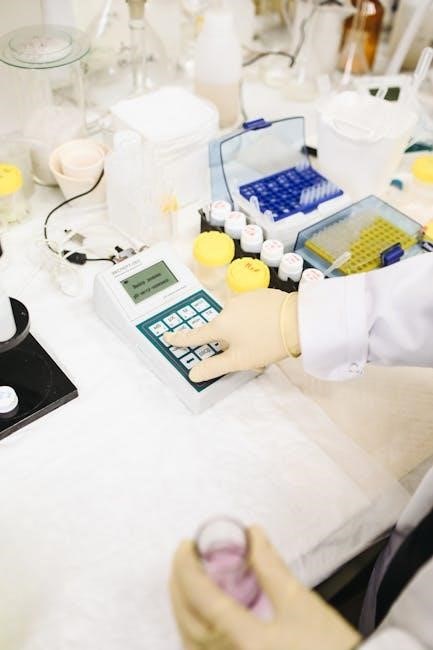
CHEM 1050 laboratory is a crucial component for students in nursing and allied health programs, designed as a one-term course building upon foundational general chemistry principles. This lab specifically focuses on providing an overview of organic and biochemistry, with a strong emphasis on practical applications relevant to the chemistry of the human body.
The course delves into essential topics such as the properties of solutions and body fluids, the intricacies of acid-base chemistry, and the diverse states of matter. Furthermore, it provides hands-on experience with various chemical reactions, fostering a deeper understanding of these core concepts.
To support student learning, the course incorporates valuable resources including comprehensive study guides covering key chapters – notably Chapters 7, 8, 9, and 10 – alongside challenging problem sets complete with detailed solutions. These materials are designed to enhance comprehension and build confidence in tackling complex chemical problems.
Course Overview and Objectives
CHEM 1050’s laboratory course is a focused, one-term experience tailored for students pursuing careers in nursing and allied health fields. The primary objective is to bridge the gap between theoretical chemistry concepts and their real-world applications within the human body. Students will gain practical skills through hands-on experimentation.
Key learning objectives include mastering techniques for analyzing solutions, understanding acid-base interactions in biological systems, and recognizing the significance of different states of matter in physiological processes. A significant portion of the course is dedicated to exploring various chemical reactions vital to life.
Successful completion of this lab will equip students with the ability to interpret experimental data, solve related problems using provided study guides, and confidently apply their knowledge to clinical scenarios. The course also emphasizes utilizing problem sets and solutions for self-assessment and improved understanding.
Importance of Lab Manuals
CHEM 1050 lab manuals are indispensable resources, serving as more than just procedural guides. They provide a structured framework for each experiment, detailing necessary safety precautions, required materials, and step-by-step instructions. Crucially, they facilitate a deeper understanding of the underlying chemical principles at play.
These manuals aren’t simply about doing the experiment; they emphasize understanding the ‘why’ behind each step. They often include pre-lab questions designed to prepare students and post-lab analysis sections to reinforce learning. Access to study guides and problem sets within the manual aids comprehension.
Furthermore, the manual acts as a permanent record of experimental procedures and observations, essential for accurate data analysis and reporting. Utilizing the provided solutions allows for self-correction and a stronger grasp of the material, ultimately enhancing success in CHEM 1050 and future coursework.
Key Concepts Covered in CHEM 1050
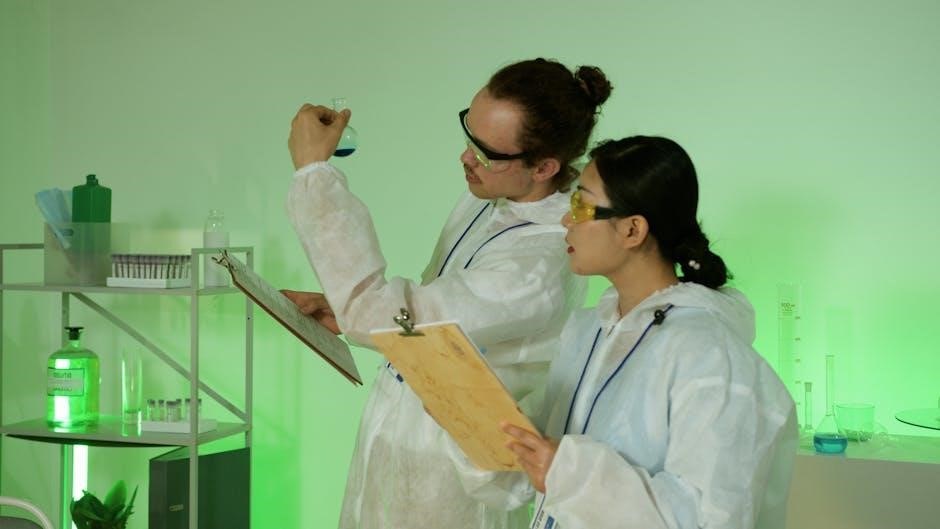
CHEM 1050 explores solutions, acid-base chemistry, states of matter, and chemical reactions, applying these principles to the chemistry of the human body.
Solutions and Body Fluids
CHEM 1050 delves into the crucial role of solutions within the context of body fluids, a cornerstone for students in nursing and allied health fields. This section emphasizes understanding the properties of solutions – concentration, solubility, and the interactions between solutes and solvents – as they directly relate to physiological processes.
The lab component likely involves analyzing various body fluids, potentially including blood plasma, cerebrospinal fluid, and urine, to determine their composition and assess their impact on overall health. Students will learn to apply concepts like molarity and normality to calculate concentrations of key electrolytes and biomolecules present in these fluids.
Furthermore, the course explores how deviations from normal solution parameters can indicate disease states. Study guides and problem sets will reinforce these concepts, ensuring a strong grasp of the chemical principles governing fluid balance and homeostasis within the human body. Understanding these principles is vital for accurate clinical laboratory diagnostics.
Acid-Base Chemistry
CHEM 1050 dedicates significant attention to acid-base chemistry, a fundamental concept in understanding physiological processes and clinical imbalances. This section builds upon general chemistry principles, focusing on pH, buffers, titrations, and the role of acids and bases in biological systems.
Labs likely involve performing titrations to determine the acidity or alkalinity of various solutions, simulating conditions found within the human body. Students will learn to calculate pH values, understand the importance of buffering systems in maintaining homeostasis, and analyze the consequences of acid-base disturbances.
The curriculum connects these chemical concepts to real-world medical scenarios, such as metabolic acidosis and alkalosis. Study guides for Chapter 10 specifically address acids, bases, and salts, while problem sets provide practice in applying these principles to clinical case studies. This knowledge is essential for future healthcare professionals.
States of Matter
CHEM 1050’s exploration of states of matter – solid, liquid, and gas – is crucial for comprehending the physical properties of substances relevant to biological systems. The lab component likely involves experiments demonstrating phase transitions, intermolecular forces, and the effects of temperature and pressure.
Students will investigate how these states influence the behavior of molecules within the body, impacting processes like respiration, circulation, and drug absorption. Practical exercises may include determining melting points, boiling points, and observing the solubility of substances in different solvents.
A comprehensive study guide for Chapter 7 provides a detailed overview of these concepts, while associated problem sets challenge students to apply their understanding to predict and explain the behavior of matter. This foundational knowledge is vital for interpreting laboratory results and understanding physiological functions.
Chemical Reactions
CHEM 1050 delves into chemical reactions, a cornerstone of biochemistry, focusing on those occurring within the human body. The lab work likely centers on identifying reaction types – synthesis, decomposition, single replacement, and double replacement – and observing evidence of reactions like gas evolution, precipitate formation, and color changes.
Students will analyze how factors such as concentration, temperature, and catalysts affect reaction rates. Understanding these principles is essential for grasping metabolic pathways and drug interactions. A dedicated Chapter 9 study guide offers a detailed overview of chemical reactions, complemented by practice problem sets.
These resources aid in predicting reaction outcomes and balancing chemical equations, skills crucial for interpreting experimental data and understanding the dynamic chemical processes underpinning life.
Specific Lab Experiments & Analysis
CHEM 1050 labs include Fe2+ analysis (Spring 2022), solution properties (Chapter 8), states of matter (Chapter 7), and chemical reactions (Chapter 9) investigations.
Analysis of Fe2+ (Spring 2022 Part 2)
The CHEM 1050 laboratory’s Spring 2022, Part 2 experiment focused on the detailed analysis of Fe2+ ions. Authored by N.S. Komissarov in 2023, and cited four times, this investigation likely involved quantitative techniques to determine the concentration of ferrous ions in a sample.
Students likely employed methods such as titration, spectrophotometry, or other analytical chemistry principles. The experiment’s objective was to provide hands-on experience with techniques commonly used in clinical laboratory diagnostics, aligning with the course’s focus on applications to the human body.
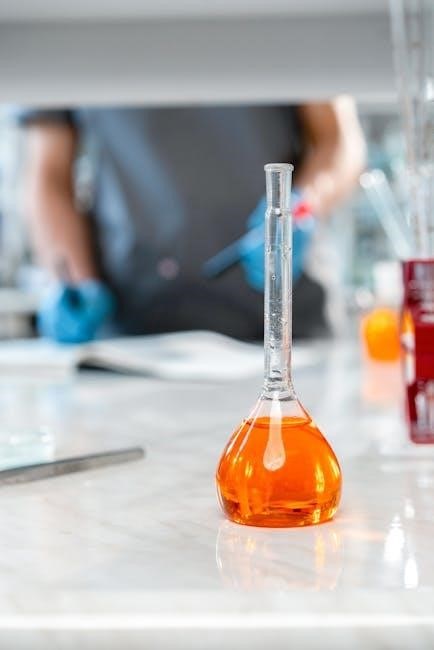
Understanding iron analysis is crucial in medical contexts, as iron levels are indicators of various health conditions. This lab likely prepared students for interpreting clinical data and understanding the importance of accurate analytical measurements. Further research explores genetic stability and long-term storage effects, potentially relating to sample preservation for accurate Fe2+ analysis.
Experiment: Properties of Solutions (Chapter 8)
CHEM 1050’s Chapter 8 experiment, focusing on the properties of solutions, is a cornerstone of understanding chemical interactions vital in biological systems. This lab likely explored concepts like solubility, concentration, and the effects of temperature on solution formation, directly relating to solutions and body fluids.
Students probably conducted experiments to determine the concentration of solutions using techniques like dilutions and molarity calculations. Investigating colligative properties – boiling point elevation, freezing point depression, and osmotic pressure – would have been central to the learning objectives.
The practical application of these principles is significant in healthcare, influencing intravenous fluid administration and drug delivery. A comprehensive study guide for Chapter 8 would aid in mastering these concepts, alongside accompanying problem sets to reinforce understanding and analytical skills.
Experiment: States of Matter (Chapter 7)
CHEM 1050’s Chapter 7 experiment delves into the fundamental states of matter – solid, liquid, and gas – and the transitions between them. This lab likely involved observing phase changes and measuring properties like melting point, boiling point, and vapor pressure, crucial for understanding chemical behavior.
Students likely explored intermolecular forces and their influence on these physical properties. Experiments might have included heating and cooling substances to determine phase transition temperatures, or investigating the behavior of gases under varying conditions.
Understanding these concepts is essential in biological contexts, such as the role of water in living organisms and the gas exchange in respiration. A dedicated study guide for Chapter 7, coupled with relevant problem sets, would solidify comprehension of these core principles.
Experiment: Chemical Reactions (Chapter 9)
CHEM 1050’s Chapter 9 experiment focuses on the identification and classification of chemical reactions. Students likely performed various reactions, observing evidence like color changes, gas evolution, and precipitate formation to determine reaction types – synthesis, decomposition, single displacement, and double displacement.
Balancing chemical equations was probably a key component, reinforcing the law of conservation of mass. The lab may have included predicting products of reactions based on reactivity series and solubility rules. Understanding stoichiometry and limiting reactants would be vital for quantitative analysis.
This knowledge is fundamental to understanding metabolic processes within the human body. A comprehensive study guide for Chapter 9, alongside accompanying problem sets, would be instrumental in mastering these reaction principles.
Study Resources & Support
CHEM 1050 offers comprehensive study guides for each chapter, alongside detailed problem sets and readily available solutions, aiding student comprehension.
CHEM 1050 Chapter 1 Study Guide: Key Concepts
Chapter 1 of CHEM 1050 lays the foundational key concepts essential for understanding subsequent laboratory experiments and theoretical applications within the course. This initial chapter serves as a crucial building block, particularly for students pursuing degrees in nursing or allied health, where a strong grasp of chemical principles is paramount.
The study guide emphasizes fundamental definitions, the scientific method, and the importance of accurate measurements. Students will explore matter’s states and properties, alongside the distinctions between physical and chemical changes. Understanding these core ideas is vital for interpreting experimental results and applying chemical knowledge to biological systems.
Furthermore, the chapter introduces basic mathematical concepts used in chemistry, including significant figures and unit conversions. Mastering these skills is critical for performing calculations accurately in lab settings and analyzing data effectively. The guide also provides problem sets with solutions to reinforce learning and build confidence.
CHEM 1050 Chapter 10 Study Guide: Acids, Bases, & Salts
CHEM 1050’s Chapter 10 delves into the critical realm of acids, bases, and salts, a cornerstone of understanding biological and clinical chemistry. This study guide is specifically designed for students in nursing and allied health, emphasizing the relevance of these concepts to the human body’s chemistry.
Key topics include definitions of acids and bases (Arrhenius, Bronsted-Lowry, and Lewis), pH calculations, buffer systems, and neutralization reactions. Students will learn how these principles govern physiological processes, such as maintaining blood pH and enzyme function.
The guide provides detailed explanations of salt formation and hydrolysis, alongside practical applications in laboratory settings. It also includes problem sets and detailed solutions to aid comprehension and skill development. Understanding acid-base chemistry is crucial for interpreting clinical lab results and understanding disease states.
Problem Sets and Solutions
CHEM 1050’s success hinges on mastering concepts through practice. Therefore, comprehensive problem sets are integral to the lab manual, designed to reinforce understanding of each experiment and theoretical principle. These sets cover a wide range of difficulty, from basic calculations to complex analytical scenarios relevant to nursing and allied health fields.
Each problem set directly correlates with the material covered in lectures and lab experiments, including topics like solution preparation, acid-base titrations, and reaction stoichiometry. Crucially, detailed solutions are provided for every problem, allowing students to check their work and identify areas needing further review.
These solutions aren’t merely answers; they include step-by-step explanations, demonstrating the correct approach and reasoning. This feature fosters independent learning and builds confidence in tackling challenging chemistry problems.
Related Fields & Applications
CHEM 1050’s principles directly apply to nursing, allied health, and clinical laboratory diagnostics, utilizing medical statistics for insightful data analysis.

Chemistry in Nursing & Allied Health
CHEM 1050 serves as a foundational course for students pursuing careers in nursing and various allied health professions. The curriculum bridges general chemistry concepts with the specific chemical processes occurring within the human body, offering a practical understanding crucial for healthcare professionals;
This includes a detailed exploration of solutions and body fluids, vital for comprehending physiological processes like electrolyte balance and intravenous fluid administration. Furthermore, the acid-base chemistry component is essential for interpreting blood gas analysis and understanding metabolic disorders. The course emphasizes the application of these principles to real-world clinical scenarios.
Students gain proficiency in analyzing chemical reactions relevant to drug metabolism, disease pathways, and diagnostic testing. The lab component reinforces these concepts through hands-on experiments, preparing students to confidently interpret laboratory results and provide informed patient care. Study guides and problem sets enhance comprehension and skill development.
Clinical Laboratory Diagnostics

CHEM 1050 provides a strong foundation for students entering the field of clinical laboratory diagnostics, equipping them with the chemical knowledge necessary to perform and interpret a wide range of medical tests. The course delves into the principles behind common diagnostic assays, focusing on the chemical reactions and analytical techniques employed in modern laboratories.
Understanding solutions, states of matter, and chemical reactions is paramount for accurate sample preparation, analysis, and quality control. Students learn how these concepts apply to analyzing blood, urine, and other bodily fluids, identifying abnormalities indicative of disease. The curriculum also covers the importance of precision and accuracy in laboratory measurements.
The practical lab work reinforces theoretical knowledge, allowing students to develop essential skills in techniques like spectrophotometry and titration. Study guides and problem sets aid in mastering the complex chemical principles underpinning diagnostic testing, preparing them for successful careers as medical laboratory technologists or technicians.
Medical Statistics Fundamentals
While CHEM 1050 primarily focuses on chemical principles, a foundational understanding of medical statistics is crucial for interpreting experimental results and applying chemical knowledge within a healthcare context. The course indirectly supports this by emphasizing precise data collection and analysis in laboratory experiments.
Students learn to evaluate the reliability of their findings, recognizing potential sources of error and understanding the importance of replicates. This analytical mindset translates directly to statistical thinking, preparing them to critically assess medical literature and research studies.
The course materials, including study guides and problem sets, encourage quantitative reasoning and the application of mathematical concepts to chemical data. Furthermore, resources like “Fundamentals of medical statistics: educational and methodical manual” complement the core curriculum, providing a pathway for students to develop statistical proficiency essential for evidence-based practice in healthcare professions.
Additional Resources
ARD Mediathek offers scientific videos, while research explores genetic stability during storage; the National Glaucoma Manual exemplifies specialized medical references for further study.
ARD Mediathek (Relevance to Scientific Video Resources)
The ARD Mediathek, Germany’s public broadcaster’s online library, presents a valuable, though perhaps unexpected, resource for students supplementing their CHEM 1050 lab manual studies. While not directly focused on chemistry, the platform hosts a diverse collection of documentaries and educational programming that can reinforce fundamental scientific principles.
Students can find visually engaging content explaining complex biological processes relevant to the course’s emphasis on the chemistry of the human body. Furthermore, programs covering broader scientific topics – physics, biology, and environmental science – can provide crucial context and enhance overall scientific literacy.
The Mediathek’s strength lies in its accessibility and the quality of its productions. It offers a different learning modality, complementing textbook material and lab experiments with dynamic video explanations. Searching for keywords related to cellular processes, molecular structures, or medical diagnostics can yield relevant results, aiding comprehension and retention of CHEM 1050 concepts.
Genetic Stability & Long-Term Storage Effects (Research Context)
Research into genetic stability and the effects of long-term storage, while seemingly distant from a foundational CHEM 1050 lab course, highlights the importance of understanding molecular degradation and preservation – concepts subtly interwoven with the course’s principles. Studies examining morphological and cultural characteristics of stored biological samples demonstrate how environmental factors impact molecular integrity.
This research context is relevant because CHEM 1050 explores the building blocks of life – proteins, nucleic acids, and carbohydrates – and their susceptibility to change. Understanding how these molecules break down over time, influenced by temperature, pH, and exposure to oxygen, reinforces the importance of proper handling and storage in laboratory settings.
Furthermore, it underscores the need for accurate analytical techniques, as degradation products can interfere with experimental results. While not a direct focus of the lab manual, this broader scientific context enriches the student’s appreciation for the complexities of biological systems and the challenges of maintaining sample fidelity.
National Glaucoma Manual (Example of Specialized Medical Manuals)

The National Glaucoma Manual, a specialized resource for practitioners, exemplifies how fundamental chemical principles underpin clinical diagnostics and treatment. While seemingly removed from a general CHEM 1050 lab course, it demonstrates the practical application of chemistry in a specific medical field.
Glaucoma diagnosis often relies on analyzing aqueous humor, a bodily fluid whose composition – pH, electrolyte balance, protein concentration – is directly governed by chemical properties explored in CHEM 1050. Understanding solution chemistry, as covered in Chapter 8, is crucial for interpreting these diagnostic measurements.
Moreover, the medications used to manage glaucoma are chemical compounds designed to interact with biological systems at a molecular level. This manual, therefore, serves as a tangible illustration of how the concepts learned in the lab – solutions, reactions, and biological molecules – translate into real-world medical practice and specialized knowledge.